|
The Week Ahead: Highlights
Asia-Pacific Preview
RBA Rate Hike Expected
By Brian Jackson, Econoday Economist
The Reserve Bank of Australia policy meeting will be the
main focus with officials widely expected to raise policy rates again after the
25 basis point increase announced last month. CPI data published since then
have shown headline inflation steady at 3.8 percent in January, above the RBA's
target range of two percent to three percent for the fifth consecutive month,
Officials have clearly indicated in their public commentary that a rate hike
will be considered at this meeting, and the impact of the Iran conflict on fuel
prices have added to concerns about the inflation outlook. Any guidance about
additonal future rate hikes will also watched closely.
Chinese activity data for January and February will also be published next
week. Separate data for these two months are not published because of the
impact of the timing of lunar new year holidays. so next week's data will
provide a clearer indication of how the Chinese economy has begun the year.
Official PMI survey data showed weak conditions in both months but the
private-sector PMU survey showed a soldi improvement in February.
Tian's central bank will hold its quarterly policy meeting with officials
likely to keep rates on hold again. Other indicators scheduled for release next
week include Australian labour market data, New Zealand GDP and trade data, and
Hong Kong inflation data.
Europe Preview
Rate Decisions and Trade Results Headline Week Ahead
By Marco Babic, Econoday Economist
Last week was a busy one, with the escalating conflict in
the middle east, and the Trump administration seeking new avenues to impose
tariffs on the US's trading partners after the initial ones were largely deemed
illegal. To add to that, the administration said it could be some time before
any refunds are issued, so there will unlikely be a quick near-term infusion of
money into the economy.
A slew of countries release their trade data next week: The
Netherlands, Norway, Belgium, Switzerland, and Italy. While it is clearly far
too early for the current events to appear in the trade numbers, they will
nevertheless provide some guidance as to how the flows of goods and services
have fared at the start of the year. Moreover, they could provide clues as to
whether there is underlying economic weakness.
On Thursday, the European Central Bank and the Swiss
National Bank will make public their decision on interest rates. The ECB has
been cautious in recent meetings as has the SNB, and rates are likely to be
kept on hold once again. In the case of Switzerland, a rate cut would be
another foray into the world of negative interest rates. And while the SNB will
make a move should economic conditions warrant, they are still more likely to
err on the side of caution.
What will be of heightened interest is what the policy
makers at both institutions have to say about economic conditions, the conflict
and inflation. Price increases have been in the comfort zone of the ECB for
some time, as have those in Switzerland. However, in February, the moved higher
in both the Eurozone and Switzerland. Once again inflation is highly likely to
be high on the list of talking points among respective governing councils.
Clearly the events unfolding in the Middle East are adding
inflationary pressures that are not yet evident in the data and will be
something to consider. Add to that the downward economic pressures, there is a
real danger of stagflation becoming a reality. Still, Europe has an advantage
with the Euro and Swiss Franc both relatively strong versus the dollar in which
crude oil is prices. Energy prices have for some time been a mitigating factor
for inflation in Europe generally, but that is about to change.
US Preview
FOMC Meeting Is Main Event
By Theresa Sheehan, Econoday Economist
In the March 16 week, attention will be focused on the
Tuesday-Wednesday FOMC meeting, the release of the meeting statement and update
to the summary of economic projections (SEP) at 14:00 ET on Wednesday, and
Chair Jerome Powell's press conference at 14:30 ET on Wednesday.
The FOMC decision will be made against a backdrop of
conflicting data reports on conditions in the labor market and an incomplete
picture of inflation. The February 28 attack on Iran quickly drove energy
prices higher and generated heightened geopolitical uncertainty which will show
up in coming months. The FOMC faces renewed "tension" in the dual mandate
between supporting maximum employment and achieving prices stability in the
context of the Fed's 2 percent inflation objective.
On the employment side, the data about the labor market
suggests that the "no hire, no fire" situation persists. The drop of 92,000 in
nonfarm payrolls in February could be a one-off related to cold weather
preventing outdoor occupations from working and a major strike by nurses in New
York. However, the onset of military actions in the Middle East without a clear
objective or conditions to end the conflict mean increased risks to the
economic outlook. Businesses and consumers will respond with caution, especially
where rapidly rising energy costs cut into discretionary purchases. This could
extend to the jobs market with delays in bringing on new hires by businesses
and households wondering about job security.
On the price stability side, Fed policymakers understand
that oil prices have surged in direct response to the war and should fall again
when peace returns and production resumes. Nonetheless, it takes more time for
prices to come down than it does for them to go up. With the duration of the
conflict an open question, there will be visible effects in the inflation
indicators. How much and how long remains to be seen. The March report on the
CPI is not until 8:30 ET on April 10 and the PPI until Aprill 14 at 8:30 ET.
These will only show the first wave of inflation impacts. If the war drags on,
it will keep fuel prices higher and household discretionary spending lower.
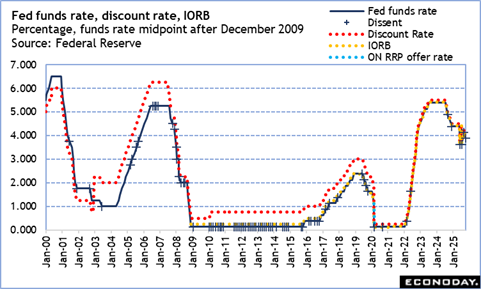
The FOMC meetings have ended with at least one dissenting
vote in favor of a rate cut since July 30, 2025. Dissenters have seen greater
risks to maximum employment and/or that tariff-driven inflation is passing
through the supply chain but not a source of entrenched inflation. Since the
last rate cut of 25 basis points on December 10, 2025, a majority of FOMC
voters have been willing to wait on the economic data for greater clarity as it
catches up after the government shutdown of October 1-November 12. A dissent
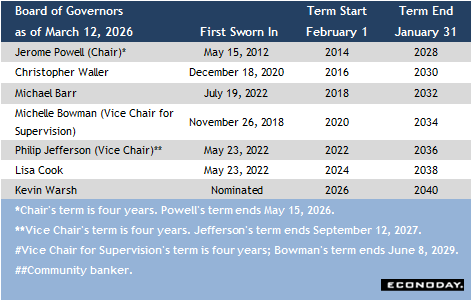
from at least one FOMC member is to be expected - Governor Stephen Miran - and
possibly one more - Governor Christopher Waller. Both will weigh the risks to
employment as greater than that of inflation.
Any clarity gained in the intermeeting period has been
muddied by the advent of war on Iran. While a rate cut is possible at the
upcoming meeting, more likely the FOMC will hold off. Powell has previously
said that the current fed funds target rate range of 3.50 to 3.75 percent is
within reach of neutral. Most on the FOMC will prefer to not cut now and have
to retrace it later should inflation become more entrenched.
The meeting will include the quarterly update to the summary
of economic projections (SEP). This will have to be parsed carefully. In
uncertain times the forecasts are more subject to revision later. Even more
than usual, the forecasts should not be read as messaging about FOMC
intentions.
When Powell takes the podium as his press briefing he will
reiterate that monetary policy is not on a preset path and that the FOMC is
committed to delivering on its dual mandate through a balanced approach. In
some ways, he will be setting the stage for his semiannual monetary policy
testimony which has yet to take place. Powell can also expect to be peppered
with questions about his plans with his term as Chair nearing its end in
mid-May. This happened at his last press briefing and he deflected with humor.
In all likelihood, he will still be chair at the April 28-29
meeting even if the confirmation hearings for Kevin Warsh are done and Warsh is
confirmed as a governor to replace outgoing Miran. Once his four-year term as chair
is done, Powell can remain as a governor until that term is complete on January
31, 2028.
The Week Ahead: Econoday Consensus Forecasts
Monday
China Fixed Asset Investment for January/February (Mon
1000 CST; Mon 0200 GMT; Mon 2200 EDT)
Consensus Forecast, Year to Date on Y/Y Basis: -3.0%
Consensus Range, Year to Date on Y/Y Basis: -4.2% to 2.0%
After an ugly 3.8 percent drop in December, the consensus
sees a slightly less bad contraction at minus 3.0 percent on year for
January/February. Extraordinary to see these declines after years of solid
gains.
China Industrial Production for January/February (Mon
1000 CST; Mon 0200 GMT; Mon 2200 EDT)
Consensus Forecast, Y/Y: 5.0%
Consensus Range, Y/Y: 5.0% to 6.1%
The consensus sees output growth pretty steady, up 5.0
percent on year the January-February after rising 5.2 percent in December.
China Retail Sales for January/February (Mon 1000
CST; Mon 0200 GMT; Mon 2200 EDT)
Consensus Forecast, Y/Y: 2.1%
Consensus Range, Y/Y: 1.1% to 4.4%
A bit of a pickup expected with retail sales up 2.1 percent
on year versus only 0.9 percent in December.
Canada Housing Starts for February (Mon 0815 EDT; Mon
1215 GMT)
Consensus Forecast, Annual Rate: 257K
Consensus Range, Annual Rate: 230K to 260K
Starts expected to rebound to 257K rate in February after
dropping to 238K in January.
Canada CPI for February (Mon 0830 EDT; Mon 1230 GMT)
Consensus Forecast, CPI - M/M: 0.6%
Consensus Range, CPI - M/M: 0.1% to 0.7%
Consensus Forecast, CPI - Y/Y: 1.9%
Consensus Range, CPI - Y/Y: 1.7% to 2.1%
CPI expected up 0.6 percent on month (NSA) in February and 1.9
percent on year after no change on month and rising 2.3 percent on year in
January.
US Empire State Manufacturing Index for March (Mon
0830 EDT; Mon 1230 GMT)
Consensus Forecast, Index: 3.9
Consensus Range, Index: -5.0 to 5.0
The consensus sees the index at 3.9 for March versus 7.1 in
February, suggesting slower growth.
US Industrial Production for February (Mon 0915 EDT; Mon
1315 GMT)
Consensus Forecast, Industrial Production - M/M: 0.1%
Consensus Range, Industrial Production - M/M: -0.3%
to 0.7%
Consensus Forecast, Manufacturing Output - M/M: 0.2%
Consensus Range, Manufacturing Output - M/M: 0.1% to 0.3%
Consensus Forecast, Capacity Utilization Rate: 76.2%
Consensus Range, Capacity Utilization Rate: 75.9% to 76.5%
Output seen up 0.1 percent in February after rising 0.7
percent in January.
US Housing Market Index for March (Mon 1000 EDT; Mon
1400 GMT)
Consensus Forecast, Index: 37
Consensus Range, Index: 32 to 38
Not much recovery expected in homebuilder sentiment with the
index nearly flat at 37 from very weak 36 a month ago.
Tuesday
Australia RBA Announcement (Tue 1430 AEDT; Tue 0330
GMT; Mon 1130 EDT)
Consensus Forecast, Change: +10 bp
Consensus Range, Change: 0 bp to 10 bp
Consensus Forecast, Level: 3.85%
Consensus Range, Level: 3.85% to 4.10%
Hawkish comments from RBA officials prompted most forecasters
to move up expectations for another 25 bp rate hike to the March meeting from
May. The minority view still looks for no change.
Italy CPI for February (Tue 0900 CET; Tue 0800 GMT; Tue
0400 EDT)
Consensus Forecast, M/M: 0.8%
Consensus Range, M/M: 0.6% to 0.8%
Consensus Forecast, Y/Y: 1.6%
Consensus Range, Y/Y: 1.6% to 1.6%
The consensus forecast sees no revision from the preliminary
gains of 0.8 percent on month and 1.6 percent on year in the February final.
Germany ZEW survey
Germany ZEW Survey for March (Tue 1100 CET; Tue 1000
GMT; Tue 0600 EDT)
Consensus Forecast, Current Conditions: -64.0
Consensus Range, Current Conditions: -68.0 to -63.7
Consensus Forecast, Economic Sentiment: 40.5
Consensus Range, Economic Sentiment: 30.0 to 55.0
The consensus looks for a weaker reading at minus 64.0 for
current conditions and 40.5 for sentiment versus minus 65.9 and 58.3,
respectively, in the prior month.
US Pending Home Sales Index for February (Tue 1000
EDT; Tue 1400 GMT)
Consensus Forecast, M/M: -1.0%
Consensus Range, M/M: -1.0% to 0.2%
Sales depressed, expected down 1.0 percent on month in
February after a decline of 0.8 percent in January.
Wednesday
Japan Merchandise Trade for February (Wed 0850 JST;
Tue 2350 GMT; Tue 1950 EDT)
Consensus Forecast, Balance: ¥-521.80 B
Consensus Range, Balance: ¥-660.00 B to ¥49.80 B
Consensus Forecast, Imports - Y/Y: 14.5%
Consensus Range, Imports - Y/Y: 9.1% to 16.2%
Consensus Forecast, Exports - Y/Y: 1.6%
Consensus Range, Exports - Y/Y: -3.5% to 4.0%
Japanese export values are projected to increase for a sixth
straight month in February
but are expected to decelerate sharply from a month earlier,
when rush shipments
ahead of the Lunar New Year prompted unexpectedly robust
trading activity. A sharp
increase in imports is expected to push the country's trade
balance into a deficit for the
second straight month.
In reaction to the sharp rise in the previous month and the
fact that this year's Lunar
New Year holiday in mainland China lasted beyond
mid-February - from Feb. 16 to 23
- trading activity with the world's second-largest economy
is expected to slow
considerably during the month, leaving exports seen rising
only 1.6% in February after
surging 16.8% in January.
In contrast, imports are expected to jump 14.5% in February
in reaction to a revised
2.4% decline a month earlier, following decreases for five
straight months through
January. Large increases in imports are expected in
semiconductor-related electronic
components, non-ferrous metals and mobile phones, while no
major items are seen
posting a significant decline during the month. Taking these
moves into account,
Japan's customs-cleared trade balance is expected to post a
deficit of ¥521.8 billion in
February for the second straight month.
Eurozone HICP for February (Wed 1100 CET; Wed 1000
GMT; Wed 0600 EDT)
Consensus Forecast, HICP - Y/Y: 1.9%
Consensus Range, HICP - Y/Y: 1.9% to 1.9%
Consensus Forecast, Narrow Core - Y/Y: 2.4%
Consensus Range, Narrow Core - Y/Y: 2.4% to 2.4%
No revision from the flash at 1.9 percent and 2.4 percent
narrow core for the final HICP.
US PPI-Final Demand for February (Wed 0830 EDT; Wed 1230
GMT)
Consensus Forecast, PPI-FD - M/M: 0.3%
Consensus Range, PPI-FD - M/M: 0.1% to 0.3%
Consensus Forecast, Ex-Food & Energy - M/M: 0.3%
Consensus Range, Ex-Food & Energy - M/M: 0.2% to 0.5%
Wholesale prices seen up 0.3 percent on month for total and ex-food
& energy
Canada Bank of Canada Announcement (Wed 0945 EST; Wed
1345 GMT)
Consensus Forecast, Change: 0 bp
Consensus Range, Change: 0 bp to 0 bp
Consensus Forecast, Level: 2.25%
Consensus Range, Level: 2.25% to 2.25%
Forecasters expect the bank to keep rates on hold at 2.25
percent this time but the odds of a rate hike later in the year have ticked up
with oil prices.
US Factory Orders for January (Wed 1000 EDT; Wed 1400
GMT)
Consensus Forecast, M/M: 0.1%
Consensus Range, M/M: -0.6% to 0.9%
The consensus sees orders nearly flat with an increase of
0.1 percent.
US FOMC Announcement (Wed 1400 EDT; Wed 1800 GMT)
Consensus Forecast, Change: 0 bp
Consensus Range, Change: 0 bp to 0 bp
Consensus Forecast, Federal Funds Rate - Target Range: 3.50-3.75%
Consensus Range, Federal Funds Rate - Target Range: 3.50-3.75%
to 3.50-3.75%
Forecasters see no action at this meeting as circumstances
are too uncertain with the Iran war under way and oil prices spiking.
Thursday
New Zealand GDP for Fourth Quarter (Thu 1045 NZDT;
Wed 2145 GMT; Wed 1745 EDT)
Consensus Forecast, Q/Q: 0.5%
Consensus Range, Q/Q: 0.5% to 0.5%
Consensus Forecast, Y/Y: 1.7%
Consensus Range, Y/Y: 1.7% to 1.7%
The consensus looks for GDP up 0.5 percent on quarter in Q4
and 1.7 percent on year versus 1.1 percent and 1.3 percent in Q3.
Japan Machinery Orders for January (Thu 0850 JST; Wed
2350 GMT; Wed 1950 EDT)
Consensus Forecast, M/M: -11.6%
Consensus Range, M/M: -13.9% to -5.5%
Consensus Forecast, Y/Y: 9.7%
Consensus Range, Y/Y: 6.2% to 16.0%
Core machinery orders are projected to fall 11.6% on the
month in January after
soaring 19.1% in the previous month, which was also
supported by ongoing services-
sector demand for computers amid an automation and
digitization drive aimed at
alleviating labor shortages. On a year-on-year basis, core
orders, excluding those from
electric utilities and for ships, are expected to rise 9.7%,
after gaining 16.8% in
December.
Australia Labour Force Survey for February (Thu 1130
AEDT; Thu 0030 GMT; Wed 2030 EDT)
Consensus Forecast, Employment - M/M: 32K
Consensus Range, Employment - M/M: 10K to 40K
Consensus Forecast, Unemployment Rate: 4.1%
Consensus Range, Unemployment Rate: 4.1% to 4.1%
The consensus sees a moderate 32K rise in employment and no
change in the jobless rate flat at 4.1 percent.
(Thu 1130 JST; Thu 0230 GMT; Thu 2230 EDT)
Consensus Forecast, Change: 0 bp
Consensus Range, Change: 0 bp to 0 bp
Consensus Forecast, Level: 0.75 %
Consensus Range, Level: 0.75 % to 0.75 %
No change is the call from the BOJ.
UK Labour Market Report for March (Thu 0700 GMT; Tue
0300 EDT)
Consensus Forecast, ILO Unemployment Rate: 5.3%
Consensus Range, ILO Unemployment Rate: 5.2% to 5.3%
The jobless rate is expected up at 5.3 percent from 5.2
percent a month earlier.
Switzerland SNB Monetary Policy Assessment for March (Thu
0830 CET; Thu 0730 GMT; Thu 0330 EDT)
Consensus Forecast, Change: 0 bp
Consensus Range, Change: 0 bp to 0 bp
Consensus Forecast, Level: 0.0%
Consensus Range, Level: 0.0% to 0.0%
The bank is expected to keep rates at zero with fx
intervention its tool of choice to hold down the rising Swiss franc.
UK BoE Announcement and Minutes (Thu 1200 GMT; Thu 0800
EDT)
Consensus Forecast, Bank Rate - Change: 0 bp
Consensus Range, Bank Rate - Change: 0 bp to 0 bp
Consensus Forecast, Bank Rate - Level: 3.75%
Consensus Range, Bank Rate - Level: 3.75% to 3.75%
The consensus sees no action pending clarity on oil prices.
US Jobless Claims for Week03/14 (Thu 0830 EDT; Thu 1230
GMT)
Consensus Forecast, Initial Claims - Level: 215K
Consensus Range, Initial Claims - Level: 215K to 220K
Claims seen at 215K in the latest week versus 213K in the
previous week as new claims remain subdued.
US Philadelphia Fed Manufacturing Index for March (Thu
0830 EDT; Thu 1230 GMT)
Consensus Forecast, Index: 5.5
Consensus Range, Index: 2.0 to 11.6
As with Empire manufacturing, slower growth seen with the
index barely positive at 5.5 in March versus 16.3 in February.
Eurozone ECB Announcement (Thu 1415 CEST; Thu 1315
GMT; Thu 0915 EDT)
Consensus Forecast, Refi Rate Change: 0 bp
Consensus Range, Refi Rate Change: 0 bp to 0 bp
Consensus Forecast, Refi Rate Level: 2.15 %
Consensus Range, Refi Rate Level: 2.15% to 2.15%
Too much uncertainty for the ECB to make any changes now.
US New Home Sales for January (Thu 1000 EDT; Thu 1400
GMT)
Consensus Forecast, Annual Rate: 728K
Consensus Range, Annual Rate: 710K to 800K
Already soft sales seen weaker at an annual 728K in January
versus 745K in December.
Friday
China Loan Prime Rate for March (Fri 0915 CST; Thu
0115 GMT; Thu 2115 EDT)
Consensus Forecast, 1-Year Rate - Change: 0 bp
Consensus Range, 1-Year Rate - Change: 0 bp to 0 bp
Consensus Forecast, 1-Year Rate - Level: 3.00%
Consensus Range, 1-Year Rate - Level: 3.00% to 3.00%
Consensus Forecast, 5-Year Rate - Change: 0 bp
Consensus Range, 5-Year Rate - Change: 0 bp to 0 bp
Consensus Forecast, 5-Year Rate - Level: 3.50%
Consensus Range, 5-Year Rate - Level: 3.50% to 3.50%
The PBOC has not signaled any change.
Canada Retail Sales for January (Fri 0830 EDT; Fri 1230
GMT)
Consensus Forecast, M/M: 1.5%
Consensus Range, M/M: 0.3% to 1.5%
Forecasters agree with Stats Canada's preliminary estimate
calling for sales up 1.5 percent in January.
|


![[Econoday]](images/econoday_logo_slim.gif)
![[Econoday]](images/logo.gif)