|
The Week Ahead: Highlights
Asia-Pacific Preview
Purchasing Managers Reports Ahead
By Brian Jackson, Econoday Economist
PMI surveys for March will be the main focus in the
Asia-Pacific region. The Flash PMI survey for India released last week showed
some moderation in conditions, and the fullest of surveys next week will be
watched for early signs that the Iran conflict has impacted activity and
sentiment in the region.
The minutes of the Reserve Bank of Australia's March meeting will be published in
the week ahead and may provide more insight into the decision to raise rates at
that meeting and guidance on whether more rate increases are likely in coming
months. Australian trade data for February are scheduled for release, as are
inflation, industrial production and retail sales data for South Korea. The
South Korean data will be followed by the Bank of Korea's next policy meeting
the following week.
Europe Preview
European Inflation's Moment of Truth
By Marco Babic, Econoday Economist
The week ahead sees the release of flash inflation data for
Europe's major economies for March which will show the impact of the conflict
in the Middle East. Recent rate decisions and policy announcements from central
banks in Europe have addressed the impact, and all are expecting inflation to
pick up. To be sure, European economies are protected somewhat from surging oil
prices due to the strength of the euro and Swiss franc against the dollar.
While price increases are clearly unwelcome and cut into consumer spending, the
main issue is that of supply and how that could be a factor for energy
production.
There had been some green shoots of optimism that order
books will recover in the coming year, particularly in France, which led to
investment in workers. That optimism given current development looks to be
misplaced.
Enter the Central Banks
Inflation has been relatively tame for at least the past
year in Europe, with that in most economies within the comfort zone of central
banks. Germany's CPI in February grew 0.2 percent month-on- month and 1.9
percent year-on-year. Italy's was up 0.7 percent and 1.5 percent month on
month, with France at 0.6 percent and 0.9 percent.
Even if hostilities ended tomorrow, there will be an impact
on inflation since, historically, prices don't climb down as quickly as they
rose. Furthermore, there is likely to be more risk built into prices and the
conflict has upended the perceived stability of the Gulf States.
For the central banks, inflation is one issue they are
mandated to keep under control. The second issue is that a global economic
slowdown, which the Swiss National Bank has cautioned about, increases the risk
of stagflation which is a harder dragon to slay that just inflation or economic
slowdown.
The upcoming data are likely to push the year-over-year
inflation rates towards or above 2.0 percent central bank inflation target in
the coming months. While core measures that exclude energy will no doubt show a
tamer inflation scenario, the fact remains that energy prices affect everyday
life.
US Preview
Jobs Data in Focus
By Theresa Sheehan, Econoday Economist
The focus of the March 30 week's data will be conditions in
the labor market. The story is expected to be the same as in recent months -
low hire and no fire.
The ADP report on private payrolls shows the four-week
moving average at an increase of 10,000 per week as of the March 7 week,
essentially unchanged from the average of 9,000 in the February 28 week and
slower than the average of 14,750 in the February 21 week and 15,500 in the
February 14 week. This points to slowing momentum in new hiring going into
March. Businesses are exercising caution about bringing on new employees as
well as having trouble finding workers with the right skills and/or experience.
However, they are also not cutting payrolls, at least not yet. The ADP national
employment report for the month of March is set for release at 8:15 ET on
Wednesday.
The Challenger report on job cut intentions for March is at
7:30 ET on Thursday. The February report showed a sharp decline of 55.5 percent
to 48,307 in February after a jump of 205.0 percent in January to 108,435 from
December. Employers probably made their biggest job cut decisions in the
post-holiday period with the elimination of planned new hires rather than
reducing existing payrolls. March should see the pace of planned job cut
actions level off and remain mostly in narrow industries where adoption of AI
tools is having the biggest impact.
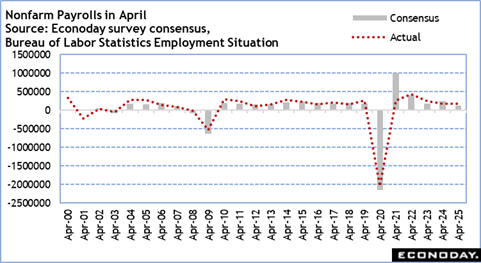
The BLS's monthly report on the employment situation for
March at 8:30 ET on Friday is expected to retrace at least some of the decline
of 92,000 in February that was largely due to special factors. Strikes by
healthcare workers have been settled and over 40,000 will be back on the job
and receiving paychecks. March should see anemic payrolls growth in the private
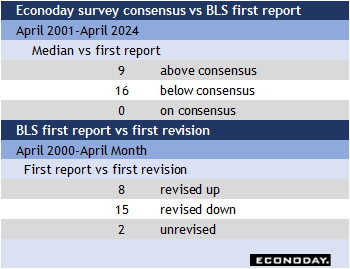
sector as only a few narrow sectors continue to hire. The first report of
payrolls in March tends to come in below consensus in part because of the
mid-month holiday in February that can slow data collection. However, the March
payroll numbers also have a strong tendency to subsequently be revised lower.
The Week Ahead: Econoday Consensus Forecasts
Monday
India Industrial Production for February (Tue 0850
JST; Mon 2350 GMT; Mon 1950 EDT)
Consensus Forecast, Y/Y: 4.3%
Consensus Range, Y/Y: 3.8% to 5.4%
Output expected up 4.3 percent on year in February versus
4.8 percent in January.
Germany CPI for March (Mon 1400 CEST; Mon 1200 GMT;
Mon 0800 EDT)
Consensus Forecast, M/M: 1.0%
Consensus Range, M/M: 1.0% to 1.2%
Consensus Forecast, Y/Y: 2.6%
Consensus Range, Y/Y: 2.6% to 3.0%
CPI expected to show increases of 1.0 percent on month and 2.6
percent on year versus 0.2 percent and 1.9 percent in February as the oil shock
effect arrives.
Tuesday
Japan Tokyo CPI for March (Tue 0830 JST; Mon 2330
GMT; Mon 1930 EDT)
Consensus Forecast, CPI - Y/Y: 1.6%
Consensus Range, CPI - Y/Y: 1.4% to 1.6%
Consensus Forecast, Ex-Fresh Food - Y/Y: 1.8%
Consensus Range, Ex-Fresh Food - Y/Y: 1.6% to 1.9%
Consensus Forecast, Ex-Fresh Food & Energy - Y/Y:
2.4%
Consensus Range, Ex-Fresh Food & Energy - Y/Y: 2.2%
to 2.5%
Retail prices at supermarkets in early March showed a
deceleration trend, while
gasoline prices rose in mid-March amid worsening tensions in
the Middle East.
Still, the impact of the Middle East situation appears
limited, keeping the Tokyo core
CPI, which excludes fresh food, below the BOJ's inflation
target of 2 percent for the second
straight month. The core CPI is expected to be flat at a
rise of 1.8 percent on the year in
March after hitting a 16-month low of 1.8 percent in
February.
Elsewhere, the total CPI is expected to be unchanged at 1.6
percent on the year in March
from a month earlier. The core-core index, which excludes
fresh food and energy, is
seen slowing to a 2.4 percent rise from 2.5 percent in
February.
Japan Unemployment Rate for February (Tue 0830 JST; Mon
2330 GMT; Mon 1930 EDT)
Consensus Forecast, Rate: 2.7%
Consensus Range, Rate: 2.6% to 2.7%
Japan's seasonally adjusted unemployment rate is seen
holding steady at 2.7 percent in February, reflecting continuing labor shortage
across a wide range of industries. Last month, the unemployment rate edged up
to 2.7 percent to the highest level since July 2024 and payroll unexpectedly
fell on the year for the first time in 42 months.
The number of employed persons in January dropped 30,000 to
67.76 million, marking the first decline in 42 months. Meanwhile, the number of
unemployed persons rose to 1.79 million, up 160,000 on the year, marking the
sixth consecutive monthly increase.
Japan Industrial Production for February (Tue 0850
JST; Mon 2350 GMT; Mon 1950 EDT)
Consensus Forecast, M/M: -2.0%
Consensus Range, M/M: -3.5% to -0.5%
Consensus Forecast, Y/Y: 0.4%
Consensus Range, Y/Y: -1.2% to 1.9%
Japan's industrial production is expected to fall sharply on
the month in February, marking its first decline in three months as exports
slow following front-loaded activity ahead of the Lunar New Year that boosted
output in the previous month.
Output is seen falling 2.0 percent on the month in February
after a revised 4.3 percent rise in January, which was up from an initial 2.2
percent increase. The January rebound was also reflected in a surge in exports
of computer chips, non-ferrous metals and plastics ahead of holidays in China
and other parts of Asia around the Feb. 17 Lunar New Year.
On a year-on-year basis, production is expected to rise 0.4
percent in February, compared with a revised 0.7 percent increase from an
originally reported 2.3 percent gain in January.
China CFLP Composite PMI for March (Tue 0930 CST; Tue
0130 GMT; Mon 2130 EDT)
Consensus Forecast, Manufacturing Index: 49.9
Consensus Range, Manufacturing Index: 49.8 to 50.2
Manufacturing business seen better at 50.2 in March versus
49.0 in February.
UK GDP for Fourth Quarter (Tue 0700 GMT; Tue 0200 EDT)
Consensus Forecast, Q/Q: 0.1%
Consensus Range, Q/Q: 0.1% to 0.1%
Consensus Forecast, Y/Y: 1.0%
Consensus Range, Y/Y: 1.0% to 1.0%
Growth rate expected unrevised at 0.1 percent on quarter and
1.0 percent on year for the final Q4 reading.
Germany Unemployment Rate for March (Tue 0955 CEST; Tue
0755 GMT; Tue 0355 EDT)
Consensus Forecast, Rate: 6.3%
Consensus Range, Rate: 6.3% to 6.3%
Rate seen stuck again at 6.3 percent in March.
Eurozone HICP Flash for March (Tue 1100 CEST; Tue 0900
GMT; Tue 0500 EDT)
Consensus Forecast, HICP - Y/Y: 2.7%
Consensus Range, HICP - Y/Y: 2.2% to 3.1%
Consensus Forecast, Narrow Core - Y/Y: 2.4%
Consensus Range, Narrow Core - Y/Y: 2.3% to 2.7%
Oil price surge driving consumer prices up, expected at 2.7
percent in March versus 1.9 percent in the February final. This is what the ECB
President Christine Lagarde was talking about when she threatened rate hikes.
Canada Monthly GDP for January (Tue 0830 EDT; Tue
1230 GMT)
Consensus Forecast, M/M: 0.0%
Consensus Range, M/M: 0.0% to 0.0%
Forecasters agree with StatsCan's advance estimate that
looks for GDP flat in January after 0.2 percent growth in December. That
reflects manufacturing plant outages offset by gains in energy sector output.
US Chicago PMI for March (Tue 0945 EDT; Tue 1345 GMT)
Consensus Forecast, Index: 54.0
Consensus Range, Index: 52.0 to 55.1
After an amazing pop into positive territory at 57.7 in
February, the consensus sees March holding strong at 54.0. After years of
contraction, this is hard to fathom.
US Consumer Confidence for March (Tue 1000 EDT; Tue 1400
GMT)
Consensus Forecast, Index: 88.5
Consensus Range, Index: 86.0 to 89.5
The consensus sees confidence down at 88.5 in March versus
91.1 in February and 89.0 in January. Worries about inflation and jobs continue
to weigh and the Iran war is darkening the picture for consumers.
Wednesday
Japan Tankan for First Quarter (Wed 0850 JST; Tue
2350 GMT; Tue 1950 EDT)
Consensus Forecast, Large Manufacturer Sentiment Index:
17
Consensus Range, Large Manufacturer Sentiment
Index: 8 to 18
Consensus Forecast, Large Non-Manufacturer Sentiment
Index: 34
Consensus Range, Large Non-Manufacturer Sentiment Index:
28 to 35
Consensus Forecast, Small Manufacturer Sentiment Index:
7
Consensus Range, Small Manufacturer Sentiment
Index: -1 to 9
Consensus Forecast, Small Non-Manufacturer Sentiment
Index: 14
Consensus Range, Small Non-Manufacturer Sentiment Index:
8 to 16
FY Current, 2025
Consensus Forecast, Large Firms Capital Expenditure Plans:
9.7%
Consensus Range, Large Firms Capital Expenditure Plans:
9.0% to 11.4%
Consensus Forecast, Small Firms Capital Expenditure Plans:
-0.6%
Consensus Range, Small Firms Capital Expenditure Plans:
-2.9% to 4.4%
The Bank of Japan's quarterly Tankan business sentiment
survey is expected to show a slight improvement among large manufacturers in
the March quarter, while the recent plunge in the number of Chinese tourists
amid bilateral diplomatic rows is seen weighing on sentiment among both large
and small non-manufacturers.
U.S. and Israeli attacks on Iran appear to have had only a
limited immediate impact on Japanese corporate sentiment. Still, concerns about
the outlook are intensifying, prompting firms to remain cautious on capital
spending as volatile global oil prices and rising domestic energy costs add to
uncertainty.
Against this backdrop, the March Tankan diffusion index for
large manufacturers is projected at 17, edging up from a revised 16, previously
15, in December and marking a fourth straight quarterly increase. The index for
small manufacturers is expected to be unchanged at 7, compared with a revised
7, previously 6.
China PMI Manufacturing for March (Wed 0945 CST; Wed
0145 GMT; Tue 2045 EDT)
Consensus Forecast, Index: 52.5
Consensus Range, Index: 51.7 to 53.0
The index is seen at 52.5 in March versus 52.1 in February.
Eurozone Unemployment Rate for February (Wed 1100 CEST;
Wed 0900 GMT; Wed 0400 EDT)
Consensus Forecast, Rate: 6.1%
Consensus Range, Rate: 6.1% to 6.2%
No change from 6.1 percent is the call.
US Retail Sales for February (Wed 0830 EDT; Wed 1230
GMT)
Consensus Forecast, Retail Sales - M/M: 0.4%
Consensus Range, Retail Sales - M/M: -0.1% to 1.0%
Consensus Forecast, Ex-Vehicles - M/M: 0.3%
Consensus Range, Ex-Vehicles - M/M: -0.1% to 0.4%
Consensus Forecast, Ex-Vehicles & Gas - M/M: 0.2%
Consensus Range, Ex-Vehicles & Gas - M/M: 0.2% to
0.3%
The consensus looks for retail sales up 0.4 percent in
February with sales ex-autos up 0. percent.
US ADP Employment for March (Wed 0815 EDT; Wed 1315
GMT)
Consensus Forecast, Jobs: 40K
Consensus Range, Jobs: 30K to 50K
The weekly ADP report has been showing jobs up 10K a week on
average in March, so that means about 40K a month.
US PMI Manufacturing Final for March (Wed 0945 EDT; Wed
1345 GMT)
Consensus Forecast, Index: 52.4
Consensus Range, Index: 52.1 to 53.5
No revision expected from the flash at 52.4.
US ISM Manufacturing Index for March (Wed 1000 EDT; Wed
1400 GMT)
Consensus Forecast, Index: 52.3
Consensus Range, Index: 52.0 to 53.0
The consensus sees the index pretty steady at 52.3 in March
vs. 52.4 in February, suggesting modest growth.
Thursday
South Korea CPI for March (Thu 0800 KST; Wed 2300
GMT; Wed 1900 EDT)
Consensus Forecast, M/M: 0.2%
Consensus Range, M/M: 0.1% to 0.6%
Consensus Forecast, Y/Y: 2.2%
Consensus Range, Y/Y: 1.5% to 3.5%
The consensus looks for CPI up 0.2 percent on month and 2.2
percent on year for March after 0.3 percent and 2.0 percent in February.
Australia International Trade in Goods for October (Thu
1130 AEDT; Thu 0030 GMT; Wed 2030 EDT)
Consensus Forecast, Balance: A$2.7 B
Consensus Range, Balance: A$1.5 B to A$3.5 B
The surplus is seen stable at A$2.7 billion in February
versus A$2.631 billion in January.
Canada Merchandise Trade for February (Thu 0830 EDT;
Thu 1230 GMT)
Consensus Forecast, Balance: -C$1.8 B
Consensus Range, Balance: -4.8C$ B to -C$1.5 B
The consensus sees the deficit narrower at C$1.8 billion for
February versus a large deficit of C$3.649 billion in January on higher oil
prices and rising auto exports.
US International Trade in Goods and Services for February
(Thu 0830 EDT; Thu 1230 GMT)
Consensus Forecast, Balance: -$60.1 B
Consensus Range, Balance: -$68.7 B to -$45.0 B
The trade gap is expected a bit wider at $60.1 billion in
February from $54.5 billion in January. This one is hard to forecast given
tariff effects.
US Jobless Claims for Week 03/28 (Thu 0830 EDT; Thu 1230
GMT)
Consensus Forecast, Initial Claims - Level: 213K
Consensus Range, Initial Claims - Level: 197K to 220K
Claims are seen up at 213K versus 210K in the previous week.
Friday
China PMI Composite for March (Fri 0945 CST; Fri 0145
GMT; Thu 2145 EDT)
Consensus Forecast, Services Index: 53.7
Consensus Range, Services Index: 53.5 to 54.5
Services seen down at 53.7 in March versus 56.7 in February.
US Employment Situation for March (Fri 0830 EDT; Fri
1230 GMT)
Consensus Forecast, Nonfarm Payrolls - M/M: 51K
Consensus Range, Nonfarm Payrolls - M/M: -25K to 75K
Consensus Forecast, Unemployment Rate: 4.4%
Consensus Range, Unemployment Rate: 4.4% to 4.5%
Consensus Forecast, Private Payrolls - M/M: 56K
Consensus Range, Private Payrolls - M/M: 30K to 70K
Consensus Forecast, Average Hourly Earnings - M/M: 0.3%
Consensus Range, Average Hourly Earnings - M/M: 0.2%
to 0.4%
Consensus Forecast, Average Hourly Earnings - Y/Y: 3.8%
Consensus Range, Average Hourly Earnings - Y/Y: 3.6%
to 3.8%
Consensus Forecast, Average Workweek: 34.3
Consensus Range, Average Workweek: 34.3 to 34.3
Payrolls seen back up by 51K after a surprise drop of 92K in
February. Jobless rate expected flat at 4.4 percent in March versus 4.4 percent
in February. Earnings growth expected at 0.3 percent, down from 0.4 percent in
February.
|


![[Econoday]](images/econoday_logo_slim.gif)
![[Econoday]](images/logo.gif)