|
The Week Ahead: Highlights
Asia-Pacific Preview
Australia Inflation, China Purchasers Reports Ahead
By Brian Jackson, Econoday Economist
Monthly CPI data for Australia will be a key focus for the
Asia-Pacific region. Although next week's data will likely be impacted by the
spike in fuel prices in response to the Iran conflict, officials at the Reserve
Bank of Australia will also be looking for evidence of broader price pressures.
Headline inflation has now been above the RBA's target range of two percent to
three percent for seven consecutive months, suggesting further policy
tightening will likely be considered in upcoming meetings. Quarterly producer
price inflation data will also be published next week.
Official PMI survey data for China will provide an early indication of
conditions in April. With the survey showing activity was already subdued in
March, the impact of the Iran conflict could weaken conditions further. South
Korea industrial production, Hong Kong trade and Taiwan GDP data will also be
published next week.
Europe Preview
Watching Impact of Energy Price Shock on Inflation
By Marco Babic, Econoday Economist
The week ahead sees a spate of inflation data for Europe
which will be closely watched given the situation In the Middle East. For some
time, consumer prices have been relatively subdued largely helped by falling
energy prices, which has kept consumer inflation well within the comfort zone
of the European Central Bank. Since the outbreak of hostilities at the end of
February, that scenario is no longer holding.
In Germany, Europe's largest economy, inflation was running at 2.7 percent
year-on-year in March, with the Harmonized Index at 2.8 percent. In France, it
was more subdued at 1.7 percent year-on-year, although the harmonized rate was
at 2.0 percent, just at the upper level of what the ECB will find
uncomfortable.
On Thursday, the April results for Europe will be released by Eurostat. In
March inflation ran at 2.6 percent while the narrow core was at 2.3 percent.
There are few, if any, reasons to think that inflation will have moderated in
April given the ongoing tensions surrounding the bottlenecks in the Strait of
Hormuz.
PMI results for April have shown anecdotal evidence that prices are becoming a
big consideration for companies. One upshot of that has been an increase in
production and order books as firms race to secure necessary inputs for their
production lines. This shows that companies are expecting a prolonged bout of
higher prices, and the question like that with tariffs is when and by how much
suppliers can pass along higher costs to their customers.
While core readings will show the degree of energy prices' impact on inflation,
the fact is that consumers won't care what the core rate is as they feel the
stress of higher energy prices. That will most likely impact discretionary
consumer spending and have a negative impact on GDP in the second quarter.
The question is when and how the ECB, the Swiss National Bank, and other
European Central banks respond to higher prices as they now have the headache
of trying to deal not just with inflation but also economic slowdown and stave
off stagflation.
US Preview
Federal Reserve Policy-makers Weigh Fallout from Iran War
By Theresa Sheehan, Econoday Economist
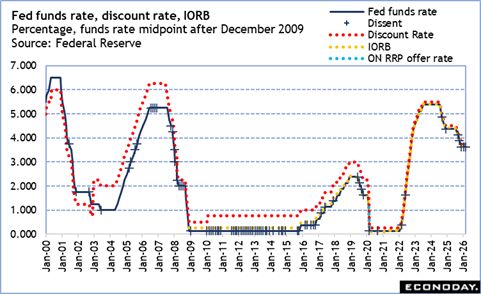
The FOMC meetings on Tuesday and Wednesday (April 28-29) are
coming against a backdrop of lengthening geopolitical uncertainty related to
the war on Iran. It is increasingly difficult to argue that the surge in oil
prices would reverse in the near term, and that impacts on the domestic and
global economies would be short-lived. Rosy predictions of positive outcomes
are looking unrealistic and only adding to the noise of trying to make sense of
events. Absent a catastrophic exogenous event, the FOMC will leave rates
unchanged for a fourth meeting in a row at 3.50-3.75 percent.
The FOMC will be trying to set policy in accordance with the
dual mandate for maximum employment and price stability. It will have to weigh
the risks in balancing the two. Concerns are growing that the moderate
underlying pace of expansion is flagging and the consequences for the labor
market. The "low hire, no fire" situation may be slipping into "no hire, no
fire". While this is not the most desirable condition for the employment
mandate, it is numbers related to inflation that will be the larger determinant
of meeting decision.
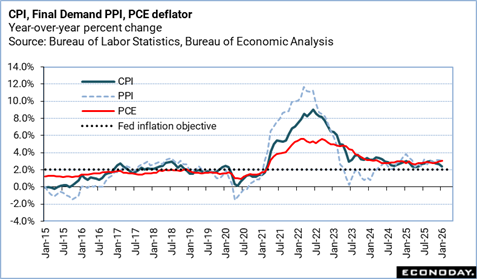
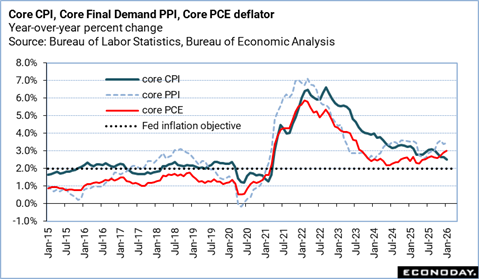
The March reports for the CPI and final-demand PPI did not
capture the full impact of the sudden and large increase in energy prices and
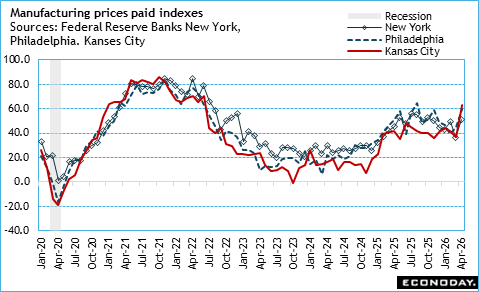
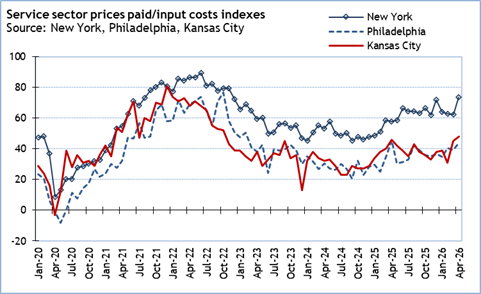
the first wave to pass-through to consumers and producers. The April indexes
for inflation will not be available until weeks after the meeting. However, the
April surveys of the manufacturing and service sectors point to big jumps input
costs that won't be expected to come down any time soon and will force
cost-cutting and/or price increases. Businesses could do either or both.
Households will face lower discretionary income and or weaker job security. The
FOMC will have to assess the risks to inflation as elevated, and probably not
just the "somewhat" that has been in use since July 24, 2024.
The FOMC is scheduled to release the meeting statement at
14:00 ET on Wednesday. The statement will be carefully parsed to see if a
majority of the FOMC are turning more hawkish on inflation. Stephen Miran
remains a holdover on the Fed board after the expiration of his term on January
31, 2026. It seems he plans to remain there until a new chair is confirmed. It
would be no surprise if he registered his sixth straight dissent in the FOMC
vote in favor of lowering the fed funds target rate.
In the meantime, Kevin Warsh had his confirmation hearing
for government and Fed chair on April 21. Even with the Department of Justice
saying it has suspended its criminal investigation of the Fed, it appears
likely his confirmation will be caught in committee for a while yet and without
a vote in the full Senate. It looks increasingly like Jerome Powell will be chair
pro tem after the expiration of his term as chair in mid-May. The logjam in the
Senate could be cleared by the June 16-17 FOMC meeting. It is not absolutely
certain that the April 29 press briefing at 14:30 ET will be Powell's last as chair.
The central theme for monetary policy of the upcoming press
briefing will center around uncertainty and the inflation outlook, and the
possibility of moving toward a recession. Powell will also be asked questions
regarding his plans. He will likely reiterate his intention to remain as a
governor until the matter around the accusations of mismanagement of the Fed
building renovations are fully resolved. He will avoid adding to any
controversy about Fed staffing and/or relations with Congress and the President.
The Week Ahead: Econoday Consensus Forecasts
Monday
Germany Gfk Consumer Climate Index for May (Mon 0600
GMT; Mon 0200 EDT)
Consensus Forecast, Index: -29.3
Consensus Range, Index: -31.0 to -29.0
The consensus sees a gloomier consumer facing rising energy
costs with the index down to minus 29.3 in May from minus 28.0 in April.
Tuesday
Japan Unemployment Rate for March (Tue 0830 JST; Mon 2330
GMT; Mon 1930 EDT)
Consensus Forecast, Rate: 2.6%
Consensus Range, Rate: 2.6% to 2.7%
Japan's seasonally adjusted unemployment rate is expected to
be unchanged at 2.6 percent in March from February. After rising to 2.7 percent
in January, the rate has held steady at 2.6 percent for five months from August
to December, highlighting firm labor market conditions amid persistent labor
shortages.
In February, employment rose 110,000 from a year earlier to
67.79 million, marking the first increase in two months. The number of
unemployed climbed by 150,000 to 1.80 million, extending gains to a seventh
straight month.
Japan Bank of Japan Announcement (Tue 1130 JST; Tue
0230 GMT; Mon 2230 EDT)
Consensus Forecast, Change: 0 bp
Consensus Range, Change: 0 bp to 0 bp
Consensus Forecast, Level: 0.75%
Consensus Range, Level: 0.75% to 0.75%
The Bank of Japan's nine-member board is expected to leave
the target for the overnight interest at 0.75 percent in a majority or
unanimous vote, pointing to the uncertainty generated by the Mideast conflict.
It would follow "no change" decisions in an 8 to 1 vote in March and January.
The bank conducted its first rate hike in six meetings in December by raising it
by 25 basis points (0.25 percentage point) to a 30-year high in a unanimous
vote.
The board is likely to repeat that it will continue raising rates if growth and
inflation evolve in line with its medium-term outlook, noting that real
interest rates are at "significantly low levels." The BOJ has been lifting the
policy rate only gradually toward a more neutral level of at least 1 percent,
noting that many firms are likely to continue raising wages into fiscal 2026
that began on April 1.
India Industrial Production for March (Tue 1600 IST; Tue
1030 GMT; Tue 0630 EDT)
Consensus Forecast, Y/Y: 3.0%
Consensus Range, Y/Y: 2.7% to 3.0%
Much slower growth seen at 3.0 percent in March versus 5.2
percent in February.
US Consumer Confidence for April (Tue 1000 EDT; Tue
1400 GMT)
Consensus Forecast, Index: 89.4
Consensus Range, Index: 87.0 to 90.4
Confidence expected to take a hit from worries about rising
prices and uncertainty flowing from the Iran war. The consensus sees the index
down at 89.4 in April from 91.8 in March.
Wednesday
Australia Monthly CPI for March (Wed 1130 AEST; Wed 0130
GMT; Tue 2130 EDT)
Consensus Forecast, Y/Y: 4.8%
Consensus Range, Y/Y: 4.4% to 4.8%
Energy price shock showing up in CPI with the annual rate
expected up to 4.8 percent in March from 3.7 percent in February.
Eurozone M3 Money Supply for March (Wed 1000 CEST; Wed
0800 GMT; Wed 0400 EDT)
Consensus Forecast, Y/Y-3-Month Moving Average: 3.1%
Consensus Range, Y/Y-3-Month Moving Average: 3.0% to 3.1%
Not much change seen in money growth, expected at 3.1
percent versus 3.0 percent a month earlier.
Eurozone EC Economic Sentiment for April (Wed 1100 CEST;
Wed 0900 GMT; Wed 0500 EDT)
Consensus Forecast, Economic Sentiment: 95.6
Consensus Range, Economic Sentiment: 94.1 to 96.3
Consensus Forecast, Industry Sentiment: -7.0
Consensus Range, Industry Sentiment: -9.0 to -6.9
Sentiment expected to show a decline to 95.6 in April from
96.6 in March amid concern over rising energy costs.
Germany CPI for April (Wed 1400 CEST; Wed 1200 GMT; Wed
0800 EDT)
Consensus Forecast, M/M: 0.7%
Consensus Range, M/M: 0.6% to 1.0%
Consensus Forecast, Y/Y: 2.9%
Consensus Range, Y/Y: 2.7% to 3.3%
Consensus Forecast, HICP - M/M: 0.9%
Consensus Range, HICP - M/M: 0.7% to 1.1%
Consensus Forecast, HICP - Y/Y: 3.1%
Consensus Range, HICP - Y/Y: 3.0% to 3.4%
The month on month increase in CPI seen up again by 0.7
percent, something of a relief after a 1.1 percent surge on the month in March,
but still a remarkable increase amid rising energy prices.
US Durable Goods Orders for March (Wed 0830 EDT; Wed
1230 GMT)
Consensus Forecast, New Orders - M/M: 0.5%
Consensus Range, New Orders - M/M: 0.3% to 1.2%
Consensus Forecast, Ex-Transportation - M/M: 0.4%
Consensus Range, Ex-Transportation - M/M: 0.3% to
1.8%
A moderate increase seen with orders expected up 0.5 percent
and 0.4 percent, ex-transportation, in March from February.
US Housing Starts and Permits for February (Wed 0830
EDT; Wed 1230 GMT)
Consensus Forecast, Starts - Annual Rate: 1.37 M
Consensus Range, Starts - Annual Rate: 1.341 M to 1.40
M
Consensus Forecast, Permits - Annual Rate: 1.39 M
Consensus Range, Permits - Annual Rate: 1.39 M to 1.39
M
US Housing Starts and Permits for March (Wed 0830
EDT; Wed 1230 GMT)
Consensus Forecast, Starts - Annual Rate: 1.40 M
Consensus Range, Starts - Annual Rate: 1.324 M to 1.438
M
Consensus Forecast, Permits - Annual Rate: 1.398 M
Consensus Range, Permits - Annual Rate: 1.35 M to 1.40
M
Rising cost pressures expected to depress housing starts to
an annual 1.37 million in February and 1.40 million rate in March from 1.487 million
in January.
US International Trade in Goods (Advance) for March (Wed
0830 EDT; Wed 1230 GMT)
Consensus Forecast, Balance: -$87.8 B
Consensus Range, Balance: -$89.5 B to -$80.2 B
Goods trade gap seen up at $87.8 billion in March versus
$84.6 billion in February.
Canada Bank of Canada Announcement (Wed 0945 EDT; Wed
1445 GMT)
Consensus Forecast, Change: 0 bp
Consensus Range, Change: 0 bp to 0 bp
Consensus Forecast, Level: 2.25%
Consensus Range, Level: 2.25% to 2.25%
BOC on hold with growth holding up surprisingly well and
policy-makers looking past the spike in gas prices.
US FOMC Announcement (Wed 1400 EDT; Wed 1800 GMT)
Consensus Forecast, Change: 0 bp
Consensus Range, Change: 0 bp to 0 bp
Consensus Forecast, Federal Funds Rate - Target Range: 3.5%
- 3.75%
Consensus Range, Federal Funds Rate - Target Range: 3.5%
- 3.75% to 3.5% -3.75%
Fed seen still in wait and see mode and no doubt pleased
that the job market appears to have stabilized. Still watching for progress on
inflation after the tariff episode, now interrupted by an energy price shock.
Thursday
Japan Industrial Production for March (Wed 0850 JST;
Tue 2350 GMT; Tue 1950 EDT)
Consensus Forecast, M/M: 0.7%
Consensus Range, M/M: -1.0% to 2.5%
Consensus Forecast, Y/Y: 3.0%
Consensus Range, Y/Y: 0.0% to 5.3%
Japan's industrial output is expected to rebound in March,
marking the first monthly increase in two months as the impact of Middle East
geopolitical tensions appears limited and exports picked up during the month.
Industrial production is seen rising 0.7 percent on the
month in March after a revised 2.0 percent drop in February, compared with an
initial 2.1% decline. The February contraction was initially driven by declines
in trucks, engines, aluminum products and liquid crystal display panels. The
subsequent upward revision reflected increases in pharmaceuticals and auto
parts, while output in the food and tobacco industries fell.
On a year-on-year basis, output is expected to rise for a
fourth consecutive month in March, increasing 3.0 percent after a revised 0.4
percent gain in February (initially 0.3 percent).
Japan Retail Sales for March (Wed 0850 JST; Tue 2350
GMT; Tue 1950 EDT)
Consensus Forecast, M/M: 0.4%
Consensus Range, M/M: -0.8% to 1.4%
Consensus Forecast, Y/Y: 1.0%
Consensus Range, Y/Y: -0.4% to 1.8%
Japan's retail sales are seen rising for the first time in
two months in March after falling in the previous month, weighed down by
sluggish clothing sales and a sharp drop in fuel prices following the
government's removal of decades-old surcharges at the end of 2025.
Retail sales are expected to increase 1.0 percent on the
year in March after a revised 0.1 percent decline in February (initially -0.2
percent). Sales are projected to rebound amid stronger department store sales.
Auto sales also appear to have picked up, with the decline in new passenger car
registrations narrowing from the previous month, while the drop in fuel
retailing is seen moderating.
On a month-on-month basis, sales are expected to rise 0.4
percent in March after falling 2.0 percent in the previous month.
China CFLP Composite PMI for March (Wed 0930 CST; Wed
0130 GMT; Tue 2130 EDT)
Consensus Forecast, Manufacturing Index: 50.1
Consensus Range, Manufacturing Index: 50.1 to
50.4
Consensus Forecast, Non-Manufacturing Index: 49.9
Consensus Range, Non-Manufacturing Index: 49.8 to 49.9
Business activity expected flat to lower with the
manufacturing index at 50.1 in March versus 50.4 in February and services down
to marginal contraction at 49.9 from 50.1.
France GDP Flash for First Quarter (Thu 0730 CEST;
Thu 0530 GMT; Thu 0130 EDT)
Consensus Forecast, Q/Q: 0.2%
Consensus Range, Q/Q: 0.1% to 0.2%
Growth expected to continue at modest 0.2 percent rate in
Q1.
Germany Retail Sales for March (Thu 0800 CEST; Thu 0600
GMT; Thu 0200 EDT)
Consensus Forecast, M/M: -0.4%
Consensus Range, M/M: -0.8% to 0.3%
Another month of losses expected with sales down 0.4 percent
in March after minus 0.6 percent in February.
Germany Unemployment Rate for April (Thu 0955 CEST;
Thu 0755 GMT; Thu 0355 EDT)
Consensus Forecast, Rate: 6.3%
Consensus Range, Rate: 6.3% to 6.4%
More of the same expected with the jobless rate flat at 6.3
percent in April.
Germany GDP Flash for First Quarter (Thu 1000 CEST;
Thu 0900 GMT; Thu 0400 EDT)
Consensus Forecast, Q/Q: 0.1%
Consensus Range, Q/Q: -0.2% to 0.2%
Consensus Forecast, Y/Y: 0.2%
Consensus Range, Y/Y: 0.2% to 0.6%
The consensus sees a sluggish 0.1 percent rise on quarter in
Q1 and a marginal 0.2 percent increase on year.
Eurozone GDP Flash for First Quarter (Thu 1100 CEST;
Thu 0900 GMT; Thu 0500 EDT)
Consensus Forecast, Q/Q: 0.2%
Consensus Range, Q/Q: 0.1% to 0.2%
Consensus Forecast, Y/Y: 0.9%
Consensus Range, Y/Y: 0.8% to 1.1%
GDP expected at 0.2 percent in Q1 versus 0.3 percent in Q4.
Eurozone HICP Flash for April (Thu 1100 CEST; Thu 0900
GMT; Thu 0500 EDT)
Consensus Forecast, HICP - Y/Y: 3.1%
Consensus Range, HICP - Y/Y: 2.6% to 3.5%
Consensus Forecast, Narrow Core - Y/Y: 2.3%
Consensus Range, Narrow Core - Y/Y: 2.2% to 2.4%
HICP seen up 3.1 percent on year in April versus 2.6 percent
in March, showing energy price shock. Narrow core seen unchanged at 2.3
percent, thankfully.
Eurozone Unemployment Rate for March (Thu 1100 CEST;
Thu 0900 GMT; Thu 0500 EDT)
Consensus Forecast, Rate: 6.2%
Consensus Range, Rate: 6.2% to 6.2%
No change seen at 6.2 percent in the jobless rate.
UK BoE Announcement & Minutes (Thu 1200 BST; Thu 0700
EDT)
Consensus Forecast, Bank Rate - Change: 0 bp
Consensus Range, Bank Rate - Change: 0 bp to 0 bp
Consensus Forecast, Bank Rate - Level: 3.75%
Consensus Range, Bank Rate - Level: 3.75% to 3.75%
BOE officials making it clear they want to keep rates where
they are for now.
Eurozone ECB Announcement (Thu 1415 CEST; Thu 1215
GMT; Thu 0815 EDT)
Consensus Forecast, Refi Rate Change: 0 bp
Consensus Range, Refi Rate Change: 0 bp to 0 bp
Consensus Forecast, Refi Rate Level: 2.15%
Consensus Range, Refi Rate Level: 2.15% to 2.15%
Consensus Forecast, Deposit Rate Change: 0 bp
Consensus Range, Deposit Rate Change: 0 bp to 0 bp
Consensus Forecast, Deposit Rate Level: 2.00%
Consensus Range, Deposit Rate Level: 2.00% to 2.00%
Until it becomes clear how long the energy shock will last,
or something else changes the picture, forecasters see the ECB and the rest of
the major central banks on hold.
Canada Monthly GDP for February (Thu 0830 EDT; Thu
1230 GMT)
Consensus Forecast, M/M: 0.2%
Consensus Range, M/M: 0.2% to 0.3%
Forecasters agree, as usual, with the Stats Canada
preliminary estimate calling for a gain of 0.2 percent on the month in
February.
US GDP for First Quarter (Thu 0830 EDT; Thu 1230 GMT)
Consensus Forecast, Quarter over Quarter - Annual Rate:
2.1%
Consensus Range, Quarter over Quarter - Annual Rate: 1.0%
to 2.8%
Consensus Forecast, Personal Consumption Expenditures -
Annual Rate: 1.5%
Consensus Range, Personal Consumption Expenditures -
Annual Rate: 1.0% to 1.6%
The consensus sees a return to healthy growth at 2.1 percent
after a cutback in government spending hit growth in Q4.
US Jobless Claims for Week 04/25 (Thu 0830 EDT; Thu
1230 GMT)
Consensus Forecast, Initial Claims - Level: 212K
Consensus Range, Initial Claims - Level: 205K to 220K
The consensus sees claims down to 212K in the week, closer
to the 4-week moving average of 210,75K, from 214 last week.
US Personal Income and Outlays for March (Thu 0830
EDT; Thu 1230 GMT)
Consensus Forecast, Personal Income - M/M: 0.3%
Consensus Range, Personal Income - M/M: 0.2% to 0.8%
Consensus Forecast, Personal Consumption Expenditures -
M/M: 0.9%
Consensus Range, Personal Consumption Expenditures - M/M:
0.3% to 1.0%
Consensus Forecast, PCE Price Index - M/M: 0.7%
Consensus Range, PCE Price Index - M/M: 0.7% to 0.8%
Consensus Forecast, PCE Price Index - Y/Y: 3.5%
Consensus Range, PCE Price Index - Y/Y: 3.5% to 3.5%
Consensus Forecast, Core PCE Price Index - M/M: 0.3%
Consensus Range, Core PCE Price Index - M/M: 0.3% to
0.7%
Consensus Forecast, Core PCE Price Index - Y/Y: 3.2%
Consensus Range, Core PCE Price Index - Y/Y: 2.9% to
3.5%
A nasty inflation reading with PCE prices expected up 0.7
percent on the month and 3.5 percent on year. Core seen up 0.3 percent on the
month and 3.2 percent on year, not reassuring at all.
US Employment Cost Index for First Quarter (Thu 0830
EDT; Thu 1230 GMT)
Consensus Forecast, Q/Q: 0.8%
Consensus Range, Q/Q: 0.7% to 0.9%
Relatively modest 0.8 percent increase seen on the quarter,
suggesting inflation pressures evident elsewhere remain restrained in the
employment market where workers aren't feeling so confident about demanding
more pay.
US Chicago PMI for April (Thu 0830 EDT; Thu 1230 GMT)
Consensus Forecast, Index: 53.3
Consensus Range, Index: 51.0 to 55.7
Forecasters see the Chicago PMI showing odd strength with
the index up to 53.3 in April from 52.8 in March.
Friday
Japan Tokyo CPI for April (Fri 0830 JST; Thu 2330
GMT; Thu 1930 EDT)
Consensus Forecast, CPI - Y/Y: 1.6%
Consensus Range, CPI - Y/Y: 1.4% to 1.9%
Consensus Forecast, Ex-Fresh Food - Y/Y: 1.8%
Consensus Range, Ex-Fresh Food - Y/Y: 1.6% to 2.0%
Consensus Forecast, Ex-Fresh Food & Energy - Y/Y:
2.3%
Consensus Range, Ex-Fresh Food & Energy - Y/Y: 2.0%
to 2.5%
The Tokyo consumer price index, a leading indicator of
nationwide price trends, is expected to edge higher across the two main
measures in April. The closely watched core CPI is seen accelerating for the
first time in six months but is likely to remain below the Bank of Japan's 2
percent inflation target for a third straight month.
The core CPI, which excludes fresh food, is projected to
rise 1.8 percent in April from a near two-year low of 1.7 percent a month
earlier. The underlying weakness of the yen continues to pose upside inflation
risks.
Elsewhere, the overall CPI is expected to pick up for the
first time since October last year, rising 1.6 percent on the year in April
after increasing 1.4 percent in March. The core-core index, which excludes
fresh food and energy, is seen holding steady at 2.3 percent.
US ISM Manufacturing Index for April (Fri 1000 EDT;
Fri 1400 GMT)
Consensus Forecast, Index: 53.0
Consensus Range, Index: 51.9 to 56.0
Another month of moderate growth is the call for ISM
manufacturing with the index expected u at 53.0 in April from 52.7 in March.
|


![[Econoday]](images/econoday_logo_slim.gif)
![[Econoday]](images/logo.gif)